🔷 Subscribe to get breakdowns of the most important developments in AI in your inbox every morning.
Here’s today at a glance:

☔ Google Flood Precognition
This amazing paper from Google reveals that their flood predictions model is on par with a state-of-the-art nowcast… except a full day five days earlier.
Here we show that artificial intelligence-based forecasting achieves reliability in predicting extreme riverine events in ungauged watersheds at up to a five-day lead time that is similar to or better than the reliability of nowcasts (zero-day lead time) from a current state-of-the-art global modelling system (the Copernicus Emergency Management Service Global Flood Awareness System). In addition, we achieve accuracies over five-year return period events that are similar to or better than current accuracies over one-year return period events.Nature
In essence:
Hydrological models take in weather data like precipitation and physical watershed formation
But, they also need to be calibrated to long data records from streamflow gauging stations in individual rivers
These are expensive, which creates huge issues as the most flood-insecure countries are also the poorest
So the countries most likely to have disastrous floods are also most likely to have flood prediction models that don’t work
Google’s machine learning model is a train once, use anywhere model, which can make predictions for rivers where no data is available
Namely the model only uses some broad aggregate globally available data along with 7 day weather forecast:
The model uses three types of publicly available data inputs, mostly from governmental sources:1. tatic watershed attributes representing geographical and geophysical variables: From the HydroATLAS project, including data like long-term climate indexes (precipitation, temperature, snow fractions), land cover, and anthropogenic attributes (e.g., a nighttime lights index as a proxy for human development).2. Historical meteorological time-series data: Used to spin up the model for one year prior to the issue time of a forecast. The data comes from NASA IMERG, NOAA CPC Global Unified Gauge-Based Analysis of Daily Precipitation, and the ECMWF ERA5-land reanalysis. Variables include daily total precipitation, air temperature, solar and thermal radiation, snowfall, and surface pressure.3. Forecasted meteorological time series over a seven-day forecast horizon: Used as input for the forecast LSTM. These data are the same meteorological variables listed above, and come from the ECMWF HRES atmospheric model.Google
The model is better than state-of-the-art up to 5 days in advance, but F-scores on SOTA are only in the 0.25 range (this is a hard problem!)
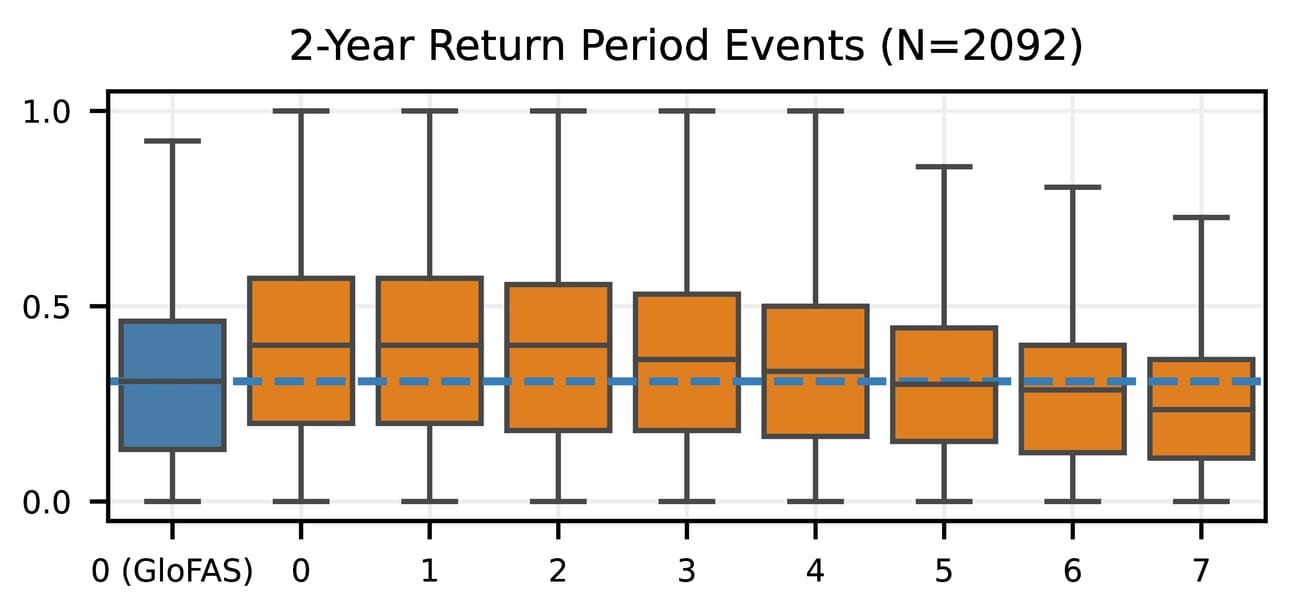
What strikes me as beautiful is that they’ve managed to extend the model to use less precise data. Because data is expensive!
🗞️ Things Happen
Deepmind releases a football manager. Football is a game of territorial aggression, so this is, of course, a future warmaking tool.


🖼️ AI Artwork Of The Day